
Home / Editorial Procedure and Peer Review
Editorial Procedure and Peer Review
DOSTP is committed to maintaining transparent, independent, impartial, and rigorous editorial practices across all its journals. Each journal is led by an Editor-in-Chief, supported by a Managing Editor, Subject Editors, Editorial Board Members, and independent external reviewers. The Managing Editor coordinates the editorial workflow, while Subject Editors oversee the scientific assessment and peer-review process. Independent experts evaluate submitted manuscripts, and editorial decisions are based on originality, scientific merit, relevance, and compliance with publication ethics. The final decision rests with the Editor-in-Chief or an appropriately delegated editor. Accepted manuscripts proceed to production and publication. All editorial decisions are made independently of commercial or financial considerations.
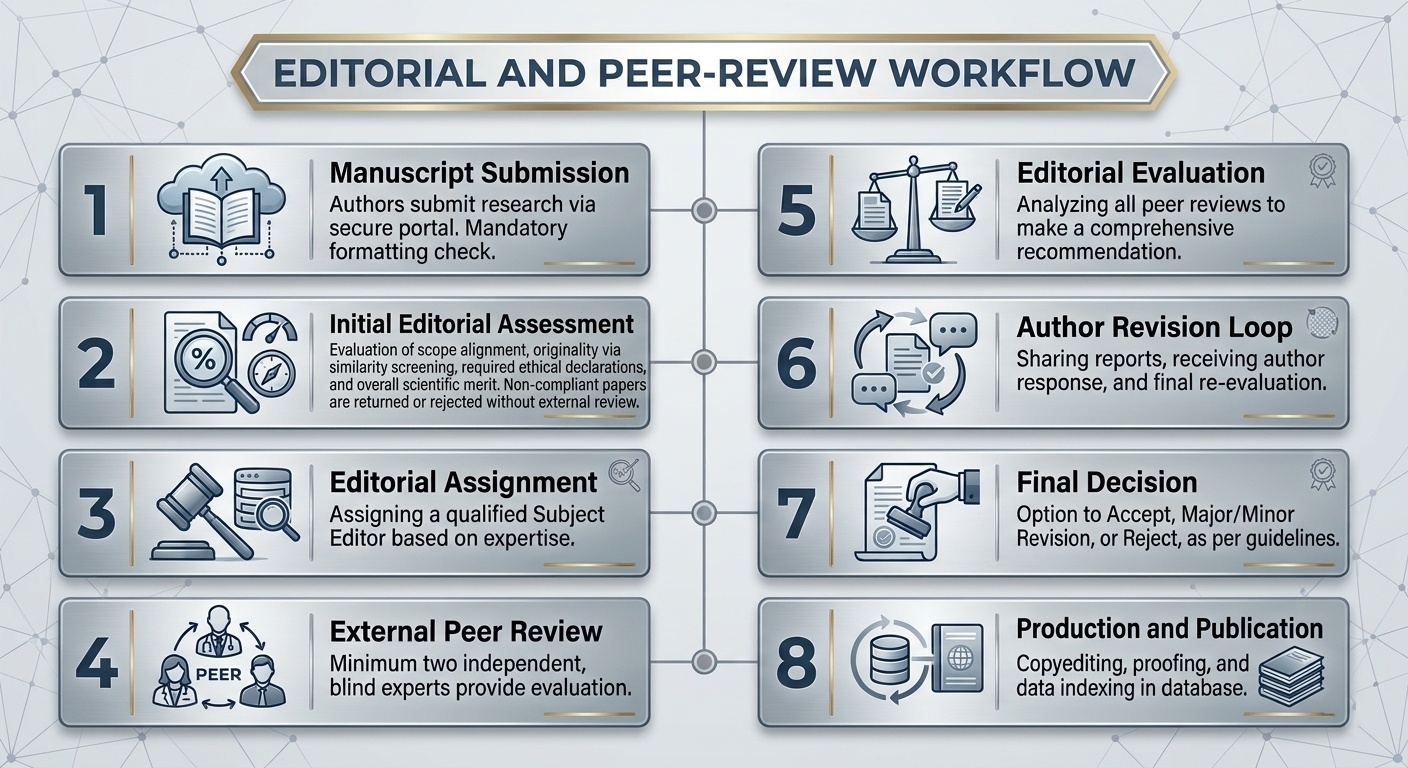
Initial Editorial Assessment
All submissions undergo a preliminary evaluation by the editorial office to verify compliance with journal requirements and publication ethics. This assessment includes verifying:
- Scope Alignment: Relevance to the journal's Aims and Scope.
- Originality: Similarity screening and potential scientific contribution.
- Completeness: Proper manuscript formatting and required declarations (authorship, funding, ethics, conflicts of interest).
- Quality Check: Preliminary research integrity and overall scientific merit.
Non-compliant submissions will be returned for correction. Manuscripts that fall outside the journal's scope, lack sufficient merit, present fundamental flaws, or raise serious ethical issues will be rejected immediately without external peer review.
Peer Review
Manuscripts passing the initial editorial assessment are assigned to the relevant Subject Editor or Associate Editor for peer review. Research manuscripts are normally evaluated by at least two independent experts through a double-blind peer-review process, unless otherwise specified by the journal.
Reviewers assess the manuscript's originality, scientific significance, methodological rigor, statistical accuracy, reliability of results, interpretation, references, ethical compliance, and overall contribution to the relevant discipline. Reviewer reports are treated as confidential and communicated to authors without disclosing reviewer identities. Based on the reviewers' comments, scientific merit, and journal standards, the Subject Editor makes an editorial recommendation.
Editorial Independence and Conflicts of Interest
Editors and editorial staff shall not participate in the evaluation or decision-making of manuscripts in which they have an authorship or other conflict of interest. Such submissions shall be handled independently by another Subject Editor with no competing interests, who will assign at least two independent external reviewers and make the editorial decision based on their reports. The review process shall follow the journal's standard double-blind peer-review policy, ensuring confidentiality, transparency, impartiality, and editorial independence; author-identifying information shall be removed from the manuscript before it is sent to reviewers.
Editorial Decisions
Based on the peer-review reports and editorial assessment, the Subject Editor or authorized editor will communicate one of the following decisions:
- Accept: The manuscript is suitable for publication in its current form and proceeds to production.
- Accept after Minor Revisions: The manuscript is suitable for publication subject to minor corrections. Authors are normally given seven days to submit the revised version.
- Reconsider after Major Revisions: Substantial revisions are required. Authors must submit a revised manuscript with a point-by-point response to reviewers' comments. Normally, one major revision round is permitted, and the revised manuscript may be sent for further evaluation.
- Reject: The manuscript is unsuitable for publication due to significant scientific, methodological, ethical, or originality concerns, or insufficient relevance to the journal's scope. Resubmission, where permitted, must be treated as a new submission.
Manuscript Withdrawal
Authors may request manuscript withdrawal by submitting a written request with justification to the editorial office. Withdrawal becomes effective only after formal confirmation by the journal. Authors must not submit the manuscript elsewhere while it remains under consideration. Duplicate or simultaneous submissions may result in appropriate action in accordance with the journal's publication ethics policies.
Author Appeals
Authors may appeal an editorial decision by submitting a reasoned written request to the editorial office, including the manuscript ID, specific grounds for appeal, and supporting scientific evidence. The appeal will be independently assessed by the Editor-in-Chief or an uninvolved Editorial Board member. The original decision may be upheld, referred for further independent review, or reconsidered. The decision following the appeal shall normally be final.
Production and Publication
Following acceptance, manuscripts undergo copyediting, typesetting, proof preparation, and final editorial checks. Authors are responsible for reviewing proofs and submitting corrections within the specified timeframe. DOIs and publication details are assigned, where applicable, before online publication and inclusion in the relevant journal issue. DOSTP aims to ensure accurate, timely, and professional publication of all accepted articles.